The Essence of Creation: Cosmogony, Mysticism, and Human Conduct in Early Hasidic Commentaries on Parashat Bereishit
Originally produced as a Master’s Thesis for M.A. in Jewish Thought, Kekst Graduate School at The Jewish Theological Seminary of America. 2021.
Introduction:
Jewish religious practitioners and authorities have been seeking God since the days of Moses and along the way have passed their knowledge down through the generations. In passing down this knowledge, many myriad books have been written over the past millennia, and a genre of particular importance has been that which centered on proper action. This phenomenon of writing to teach correct conduct has brought forth such great works as Maimonides’s Mishneh Torah, Moses Cordovero’s Tomer Devorah, Elijah de Vidas’s Reishit Ḥokhmah, Joseph Karo’s Shulchan Arukh, The Duties of the Heart by Baḥya ibn Pekudaand many many more Halakhic and Musar works that seek to instruct the reader on how to behave throughout daily life. On the other hand, the works of Kabbalah, which sought to pass on esoteric teachings of the inner workings of God, such as Sefer haZohar or Isaac Luria’s teachings communicated through Pri Etz haḤaim, have also included practices intended to assist the mystic seeker in serving or cleaving to God. While the aforementioned codes of law or ethical works may leave the spiritual seeker wanting for theosophical knowledge, the kabbalistic works can be extremely inaccessible for the uninitiated (and even for the learned scholar),[1] without fully explaining how the teachings are relevant to daily service of God.
Between these two approaches, Ḥasidism entered to find a meeting point where the practice and the purpose could be explained simultaneously, influenced by various internal and external sources including simplifying Lurianic kabbalah and Renaissance magical practice.[2] As Gershom Scholem wrote,
Hasidism… broadly speaking represents an attempt to make the world of Kabbalism, through a certain transformation or re-interpretation, accessible to the masses of the people, and in this it was for a time extraordinarily successful.[3]
In this study, I intend to show how the early writers of Hasidic commentaries on the Torah used kabbalistic understandings to teach ethical imperatives through the creation narrative of Genesis chapter one as an integral part of making Torah relatable to contemporary Jews.
Tomer Devorah and Early Musar Texts
To understand how the early Hasidic authors ultilized earlier works, let us first examine a cornerstone of early Kabbalah and Musar—Moshe Cordovero’s foundational work Tomer Devorah. Cordovero (1522-1570) is a giant in the realm of early Kabbalah. He was teacher to many of the most well-known masters, including Eliyahu de Vidas, Hayim Vital, and briefly Isaac Luria.[4]
Although Cordovero was a fairly prolific writer, Tomer Devorah holds a special place in the hearts and shelves of many who have had the pleasure to learn it. Patrick Koch notes that:
Cordovero’s famous short treatise Tomer Devorah (The Palm Tree of Devorah) is arguably his most popular work, as it appeals to a much wider audience, i.e. one less familiar with esoteric matters. However, this unusual accessibility does not mean—as some scholars seem to think—that the path laid out in Tomer Devorah is at all simple to accomplish, or that Cordovero’s demands on his readers are in any way less strenuous.[5]
Tomer Devorah sets out to explain how one should practice embodying the holy attributes of God in order to gain spiritual heights through imitatio dei. In his section on the attribute of Yashuv Rahamekha (“He returns his mercy/compassion”), Cordovero outlines that God acts in a different manner than human beings, who tend to reject others who have wronged them and hold grudges even if the wrong-doer has tried to make recompense. God, on the other hand, not only accepts back with compassion one who has transgressed and repents, but even holds them in higher esteem than before they had transgressed! Cordovero relates this behavior to the very nature of the universe, created through the letter hey:
(in b. Menaḥot 29b) On the matter of the hey: why is it made [to look] like a [Greek] portico? So that all who want to exit from His world may go out. This explains [the teaching that] the world was created through [the letter] hey, and the Holy One, blessed be He, created the world wide-open towards the side of evil and transgression, and no side is without materiality, the evil inclination, and deficiency—like a portico which has no fence, but rather has a great opening [which is] open to the side of evil, the downward side (the bottom of the hey). All who wish to exit from His world have several openings [to choose from], [indeed] one cannot turn to a side where he cannot find transgression and wrongdoing through which he can enter to the outside (demonic) forces. Yet it, [the hey] is open above [as well] so that if the person repents it will receive him. [6]
במְנָחוֹת כט:) בְּעִנְיַן ה לָמָּה הִיא עֲשׂוּיָה כְּאַכְסַדְרָא שֶׁכָּל הָרוֹצֶה לָצֵאת מֵעוֹלָמוֹ יֵצֵא
פֵּרוּשׁ הָעוֹלָם נִבְרָא בַּה' וְהַקָּדוֹשׁ בָּרוּךְ הוּא בָּרָא הָעוֹלָם פָּתוֹחַ לְצַד הָרַע וְהַחֵטְא לִרְוָחָה אֵין צַד שֶׁאֵין חֹמֶר וְיֵצֶר הָרַע וּפְגָם כְּמִין אַכְסַדְרָא, אֵינוֹ בַּעַל גְּדָרִים אֶלָּא פִּרְצָה גְּדוֹלָה פְּרוּצָה לְצַד הָרַע לְצַד מַטָּה
כָּל מִי שֶׁיִּרְצֶה לָצֵאת מֵעוֹלָמוֹ כַּמָּה פִתְחִין לוֹ לֹא יִפְנֶה לְצַד שֶׁלֹּא יִמְצָא צַד חֵטְא וְעָוֹן לִכָּנֵס אֶל הַחִצוֹנִים, וְהִיא פְתוּחָה מִלְּמַעְלָה שֶׁאִם יָשֻׁב יְקַבְּלוּהוּ
Here, Cordovero utilizes a midrash taught in the Talmud (and quoted by Rashi in his commentary on Genesis 2:4) which teaches that the world was created through the letter hey. This creation detail is then used to discuss repentance and the standing of one who repents (in the Talmud and for Rashi, this is primarily a discourse on the afterlife). However, Cordovero includes later a relatively short paragraph on how knowing the detail of creation through the letter hey should impact a person’s behavior while in this world. He says:
And this is how a person should behave with his fellow man: He should not bear hatred [which comes] from a previous anger, rather when he sees his fellow he should strive to love him, from the level of Raḥamim and love, more and more than before and he should say, “he is to me like a truly penitent one, in whose place the completely righteous ones are unable to stand.” Thus he will absolutely draw in [the fellow], more closely than he would have drawn others in who had been completely righteous with him, who had never transgressed against him.[7]
וְכָךְ הָאָדָם צָרִיךְ לְהִתְנַהֵג עִם חֲבֵרוֹ לֹא יִהְיֶה נוֹטֵר אֵיבָה מֵהַכַּעַס הַקּוֹדֵם אֶלָּא כְּשֶׁיִּרְאֶה שֶׁחֲבֵרוֹ מְבַקֵּשׁ אַהֲבָתוֹ יִהְיֶה לוֹ בְּמַדְרֵגַת רַחֲמִים וְאַהֲבָה יוֹתֵר וְיוֹתֵר מִקֹּדֶם וְיֹאמַר הֲרֵי הוּא לִי כְּבַעֲלֵי תְּשׁוּבָה שֶּׁאֵין צַדִּיקִים גְּמוּרִים יְכוֹלִים לַעֲמֹד אֶצְלָם
וִיקָרְבֵהוּ תַּכְלִית קֻרְבָה יוֹתֵר מִמַּה שֶׁמְּקָרֵב אֹתָם שֶׁהֵם צַדִּיקִים גְּמוּרִים עִמּוֹ שֶׁלֹּא חָטְאוּ אֶצְלוֹ
From learning that creation was performed through the letter hey, we now come to find that the important take-away is that a person should not bear a grudge derived from hate against his fellow person because God does not hold wrong-doing against the repentant. How can one overcome what seems to be human nature and void the hate and resentment that wants to come out against others who are trying to make amends? According to Cordovero, by exercising love and compassion whenever you see that person, by saying to yourself, “that person stands in a place even the righteous cannot stand.” By doing this, a person reflects the divine attributes and makes themselves a more refined reflection of the divine image.
Reishit Hokhmah: The Beginning of Wisdom
One of Moshe Cordovero’s most prominent students was Eliyahu de Vidas. Based largely on Cordovero’s teachings and primarily after his death, de Vidas wrote Reishit Hokhmah—and although Tomer Devorah preceded it in existance, Reishit Hokhmah was published first in 1579 and is therefore considered the first ethical-kabbalistic work.[8] Similarly to Tomer Devorah, de Vidas tends to make a claim and then provide prooftexts, rather than structuring the work as a commentary on the Hebrew Bible. Nevertheless, these works were very influential to those later Hasidic homileticists who delivered their expositions weekly on the Parashat haShavuah. To get a taste of Reishit Hokhmah and its approach to kabbalistic ethics, presented below is a short excerpt from the “Gate of Love: Chapter Ten” (translated by Lawrence Fine):
Moreover, an individual should reflect and say to himself: “Behold, all the heavenly hosts serve Him in great gladness and are joyful to perform the will of their Maker.” Their heavenly devotion is twice as great as ours, for the heavenly spheres never cease their activity. Likewise, the sun eternally rotates and each morning when it rises, it does so in joy… The sun also sings before God, as it says in the Zohar [II, 196a]... And inasmuch as all the heavenly spheres bring forth song out of their longing to cleave to God, so must a person also sing and praise God in order to gladden his Maker and to cleave to Him. For song facilitates cleaving to God in that a person recalls the many benevolent and compassionate things which He does for him...[9]
This passage illustrates de Vidas’ method of conveying his ethics. The imperative of this section is to “sing and praise God,” and the reason given is that the heavenly hosts also “serve [God] in great gladness and are joyful to perform the will of their Maker.” Even though these supernal servants are twofold greater than humankind, we nevertheless must sing and remember God’s compassion for the world. As will be seen below, the kabbalistic ethicists have a penchant for naturalism, which is expressed through the use of Genesis chapter one in conveying ethical instruction by the later teachers, in particular the Hasidim of the Ba’al Shem Tov.[10]
Creation Narrative as Gateway for Ethical Instruction in Hasidic Literature
Hasidic commentaries (or hermeneutics) by following the Hebrew biblical narrative, give a format to the dissemination of ideas that otherwise might be inaccessible due to the “complicated and often abstruse mystical vocabulary” of the older kabbalistic works.[11] Explaining the Torah verse-by-verse (or at least parshah-by-parshah) gives a two-fold opportunity for teaching: it allows the homilist to explain how Torah is relevant to the reader’s life and gives ample occasion to teach new customs, pietistic practices, or ethical ideas or to show how an established custom or idea is rooted in the Torah. As Joseph Dan notes,
Hasidism is the only religious movement in Jewish history which expressed itself almost exclusively by means of homiletical and ethical literature. In the first thirty-five years in which Hasidic works were printed (1780-1815), all the works written and printed by the adherents of the new movement were compilations of ethical sermons based on the terminology of kabbalistic symbolism, or ethical works written in the same way… for the Hasidim religion and ethics were one and the same, and ethical expression encompassed the totality of their world view.[12]
With the understanding that religion and ethics are one and the same, it follows that any religious text would constitute an opportunity and method for espousing ethical teachings. A beautiful example of this, before we turn to longer and deeper engagement with some of the earliest published Hasidic commentaries, but which serves to demonstrate in a clear way how the earlier Musar texts carried over into Hasidic teachings, comes from Avodat Yisrael on Parashat Bereishit, by Yisroel Hopstein of Koznitz (1735-1814):
“And The LORD God said, ‘it is not good for the Adam to be alone…’” (Gen. 2:18). It says in the Yalkut [Shimoni] (Bereishit, Remez 22), “this is one of the ten declarations by which the world was made, as it is said, ‘and the ruah (wind/spirit) or God hovered…’” (Gen. 1:2). It is already known that the world was created through ten declarations (Avot 5:1), but the Mekabbelim (kabbalists) wrote that they correspond to the ten sefirot and wrapped the Holy One, blessed be He, in the dressing of the ten Holy Attributes. So, according to their form a person should behave [here] below, so that he will be a throne of glory for the Holiness of His will, may He be blessed; and as has been written in the holy books, especially in Tomer Devorah, look there.[13]
ויאמר ה׳ לא טוב היות האדם לבדו וגו׳. אתיא בילקוט (בראשית רמז כב) ׳זה אחד מעשרה מאמרות שנברא בהם העולם, ואית דאמרי ורוח אלקים מרחפת וגו׳. כבר נודע שהעולם נברא בעשרה מאמרות (אבות פ׳׳ה מ׳׳א)
וכתבו המקבלים שהם נגד עשר ספירות ונתעטף הקדוש ברוך הוא בהתלבשות עשר מדות הקדושות, וכתבניתם יתנהג האדם כלמטה ויהיה כסא כבוד לקדשת רצונו יתברך וכמו שכתבו בספרים הקדושים בפרט בספר תמר דבורה יעין שם
Connecting the phrase “it is not good for man to be alone” to the ten declarations that preceded creation and then connecting those to directives for human behavior is exactly the kind of innovative cosmogonically derived mystical ethics that I will show are not only a common theme in early Hasidic commentaries, but are necessary for proving that Torah is relevant; every verse contains wisdom and guidance pertaining to our daily lives and actions.
Toldot Ya’akov Yosef - The First Hasidic Book:
To begin to see how these early authors went about turning the narrative of creation into a discussion of ethical conduct, we will begin with the first published work of Ḥasidic Torah commentary, Toldot Yaakov Yosef written by Rabbi Jacob Joseph of Polnoye and first published in 1780, making it also one of the few texts published during the author’s lifetime.[14] Rabbi Jacob Joseph (1710-1784) was a prominent and early disciple of the Ba’al Shem Tov (Israel ben Eliezer) the founder of modern Ḥasidism and many of R. Jacob Joseph’s teachings are reorderings or repetitions of the Ba’al Shem Tov’s teachings (he himself did not write down any teachings).[15] David Biale, et al, in the important recent work Hasidism: A New History, notes that:
Ya’akov Yosef’s voluminous homiletical discourses have been regarded by Hasidim and academic scholars alike as the foremost foundational texts of Hasidism… These books exhibit prodigious scholarship, drawing extensively on a wide range of canonical rabbinic sources. Not surprisingly, they are suffused with the Kabbalistic ethos characteristic of the mystical pietism that Ya’akov Yosef had embraced long before he encountered the Besht.[16]
Let us turn now to R. Jacob Joseph’s comments on the first chapter of Genesis, where he explains:[17]-[18]
“In the beginningGod…” (Gen. 1:1) initially G-d created [the world] through Din (Judgement), (but) He saw that as such the world was not able to be established in partnership with Raḥamim (mercy), as it is said (Gen. 2:4), “on the day Hashem Elohim made earth and heavens…”
But there is a difficulty (due to the reversal of “the heavens and the earth” in Gen. 1:1): was there a change in divine will, God forbid? Even though it is written in Etz Ḥaim (Vital) that the attribute of Din was a necessity of the secret of the tzimtzum (self-constriction), that afterwards Raḥamim is the straight line, etc. look there.
Furthermore, this plan of creating the world was from the side of Ḥesed (providence) and generosity which rose in His will, may He be blessed, so how is it possible to say that it was only the attribute of Din initially, and moreover by the attribute of Din the heavens preceded the earth, and afterwards Din joined with the attribute of Raḥamim so that earth preceded heavens?[19]
בראשית ברא אלהי' בתחלה בראו בדין ראה שאין העולם מתקיים שיתף מדת הרחמים שנאמר ביום עשות ה' אלהי' ארץ ושמים וכו
ויש להקשות וכי יש שינוי רצון חס ושלום לפניו, הגם לפי מה שכתב בעץ חיים הוצרך בחינת דין בסוד הצמצום, ואחר כך רחמים קו הישר וכו' יעו"ש
ועוד הא תכלית בריאת עולם היה מצד החסד והנדבה שעלה ברצונו יתברך, ואיך אפשר לומר שהיה רק מדת הדין בתחלה ועוד במדת הדין הקדים שמים לארץ ואחר כך בשיתוף מדת הרחמים עם מדת הדין הקדים ארץ לשמים
Even from this small section of exposition two points become clear: the first, that R. Jacob Joseph is very fluent in the symbols and vocabulary of kabbalah and is clearly influenced heavily by Lurianic kabbalah, even referring the reader to Vital’s Etz Haim, although he prefers using the earlier term מדה—middah/attribute to refer to Din, and Rahamim, rather than ספירה—sefirah/emanation which is prominent in Lurianic theology. Additionally, R. Jacob Joseph is obviously well-read and expects his reader to be similarly literate. He makes this clear by mentioning five books to which the reader is instructed to “look there” for additional information.[20]
While Scholem has noted that the Ba’al Shem Tov “evolved a new form of religious consciousness in which rabbinical learning, whatever its intrinsic significance, played no essential part,” it seems that for his disciples, such as R. Jacob Joseph, the study of rabbinics was not only a significant part of their own worldview and practice, but an activity they were eager to promote.[21]
The central question in this paragraph becomes the difficulty arising from the flipped ordering of “heaven” and “earth” between Genesis 1:1 and Genesis 2:4. Although this paragraph does not enter into the realm of ethics just yet, it sets up for the reader that R. Jacob Joseph is approaching the text from a kabbalistic point of view, and the reader might already expect to see him connect these cosmogonical verses to human action in the coming paragraphs. Indeed, it does not take long for the issue of the sun and moon—“the two great lights” to present itself for R. Jacob Joseph’s attention, an opportunity to which he avails himself for the purpose of teaching about the importance of two types of people; those who are wise in Torah and those who are wealthy:
To clarify what was said, “and Elohim made the two great lights, the great light to govern the day, and the lesser light to govern night…” (Gen. 1:16) Our sages of blessed memory explained they were created equal, and the moon said it was impossible for two kings to use one crown so she was made lesser, etc. But there is a problem with “it is impossible for two kings, etc.” How could they be created equal? And if it was possible, how could she speak [those words]?
Although I saw it written in a certain book, that according to the sages the character of the moon is that she does not have light except for that which she receives from the sun, and this is what is said, “go for yourself, and see that you have no light from yourself,” if so there are not two kings, etc. the words of the wise are favorable. But according to this, how does it say “two great lights” after [saying] she does not have [her own] light?
And it occurs to me that the reason that they are called “two great lights” is in the Midrash (Shemot Rabbah 31:5) that David was earnestly seeking from Hashem, may He be blessed, “may he dwell forever before Elohim, assign Hesed and Emet to watch over him” (Ps. 61:8), that his wealth would be measured by this attribute and would be weighed out according to Din “for this as for that” and it would not be one of great wealth from the side of Rahamim and one of poverty from the side of Din.
So Hashem, may He be blessed, responded, “if so, Ḥesed and Emet are assigned to watch over him” that Hesed be required to repay “this for that,” since through [Hesed] the world was created. But, when they become equals, this Hesed will not be required from this, etc.,
I concluded to ask if it does work well for wealth, then for learning there is still a problem [when it is a metaphor] that this one [the great light] is a wise student and that one [the lesser] is a ignoramus, but it is fitting that they all should know Torah from the small to the great.
Then I elaborated, that on account of this the outpouring would only be from one side and the will of the Creator would be to cause this outpouring of wealth and of Torah and ethics. Then they will both be called “great lights” which each pour out its light to its partner, as mentioned above.[22]
ונבאר מה שנאמר ויעש אלהי' את שני המאורות הגדולים את המאור הגדול לממשלת היום ואת המאור הקטן לממשלת הלילה וכו', ודרשו חכמינו ז"ל שוין נבראו ואמרה הלבנה אי אפשר לשני מלכים שישמשו בכתר אחד נתמעטה וכו', ויש להקשות אם אי אפשר לשני מלכים וכו' איך נבראו שוין, ואם אפשר איך אמרה
הגם שראיתי כתוב בספר אחד כי לפי חכמי התכונה הלבנה אין לה אור רק מה שמקבלת מהשמש
וזה שאמר לכי לעצמך ותראה שאין לך אור מעצמך, ואם כן אינו שני מלכים וכו' דפח"ח. אך דלפי זה איך אמר שני מאורות גדולים מאחר שאין לה אור.
ונראה לי טעם דנקרא שני מאורות גדולים דאיתא במדרש שוחר טוב ששאל דוד מהשם יתברך ישב עולם לפני אלהי', שיהיה עושר קצוב לזה במדה ומשקל על פי הדין לזה כמו לזה ולא שיהיה אחד עושר גדול מצד הרחמים, ואחד עני מצד הדין
והשיבו השם יתברך אם כן חסד ואמת מן ינצרוהו, שצריך שיגמול חסד זה עם זה שבזה נברא העולם, וכשיהיו שוין לא יצטרך זה החסד מזה וכו
והקשתי לשאול תינח בעושר אך בלימוד עדיין הקושיא במקומה עומדת שזה תלמיד חכם וזה עם הארץ, ומהראוי שיהיו כולם יודעים התורה מקטן וגדול,
ובארתי דלפי זה לא יהיה השפע רק מצד אחד, ורצון הבורא שישפיעו זה בעושר וזה ישפיע בתורה ומוסר,
ואז נקראו שניהם מאורות הגדולים שישפיע כל אחד אורו לחבירו, ועיין מזה לעיל
An important point we can uncover from this section is that ultimately R. Jacob Joseph wants to teach something relatable. Thus the “two great lights” are not to be understood simply as the sun and moon, but as a wealthy person (the sun) and a pauper (the diminished moon), and as the wise scholar (the shining light) and the ignoramus (who has no light of its own and shines only when reflecting the light of the sun). On account of this lesser light—the ignoramus—God created the world through mercy, so that rather than being judged harshly, this person might also learn Torah and then both lights will be “great” and can shine or “pour out” to each other (that is to say, they will teach each other Torah). Rabbi Jacob Joseph continues:
Indeed a single intelligence also influences its companion in a manner such that both are called “great lights.” Truthfully in every place there is only one great light, and one lesser light, because the wise student who pours out his Torah is the great light, and if you would say that a common wealthy man gifted to him [the wise student] from his wealth, then it is also fitting to call him [the wealthy man] great. This I can only explain through the Mishnah [Pirkei] Avot (3:7), “give to him from what is yours, as you and what is yours are His,” because “the entire world is sustained for the sake of Hanina my son” (Berahot 17b). If so, the wealthy man gives to the wise student from what is his. Returning to the issue, why are they both called great? So we are compelled to say the reason is written in the Zohar, “be the tail of lions” because all the time that he is connected to the great one, like a lion, if he is a lion’s tail, he will also be known as a lion everywhere, so too he will be called “great.” Look there.[23]
איברא גם שכל אחד משפיע לחבירו באופן שנקראו שניהם בזה מאורות הגדולים, מכל מקום באמת אינו רק מאור אחד גדול ומאור אחד קטן, כי התלמיד חכם המשפיע בתורתו הוא המאור הגדול, וכי תימא הא האיש המוני העשיר משפיע לו גם כן מעשרו גם כן ראוי לקרוא גדול
זה אינו דבארתי במשנה דאבות תן לו משלו שאתה ושלך שלו, כי כל העולם ניזון ב׳׳שביל חנינא בני, אם כן נותן לו העשיר לתלמיד חכם משלו, והדרא קושיא מה זה שנקראו שניהם גדולים
ועל כרחך היא מטעם שכתב בזוהר הוי זנב לאריות, כי כל זמן שהוא מחובר אל הגדול כמו אריה, גם שהוא זנב אריה
מכל מקום בתואר ארי' נקרא וכו', וגם הוא נקרא גדול וכולי יעו"ש
The problem of having “two great lights,” is moreover resolved by detailing the ways in which there can be both two great lights, even as one is greater and one lesser. When a superiorly learned scholar teaches Torah to a less educated person, both of them are called “great,” as R. Jacob Joseph says that an “intelligence influences its companion in a manner such that both are called “great lights.” Even though the uneducated mind is at that time reflecting the light of the wise one, “the greater and the lesser” being revealed, they are also both great. Furthermore, if a wealthy non-scholar supports a scholar by giving said scholar money, the wealthy one is at that moment called “great.” The wealthy tradesman—the “materialistic person”— who is called great when pouring out his wealth to the scholar or by nature of being connected to him, is also later connected to “Earth” and the spiritually centered scholar to “Heaven.”[24] This connection places the scholar first in Genesis 1:1, and the tradesman first in Genesis 2:4, a hermeneutical maneuver that seems to make these two people equals.
In this final section from Toldot Ya’akov Yosef, we can see how R. Jacob Joseph completes his thoughts on the “great lights” and the purpose of the world:
By this one can understand “and Elohim made the two great lights” (Gen. 1:16) in the secret of the Tikkun (repair); but the expression and the thought were not so, as I will explain.
The purpose for making and creating the world is they should be joined together to both be called great, and not only that materialistic people will pour out to wise students, the spiritual people, through their wealth but that the wise students, the spiritual people, will pour out their Torah to the materialistic people as this is “a world of Hesed He will build” (Ps. 89:3); that in every place, only one will be called a great light, since the wise student influences both of them because “the world is sustained for the sake of Hanina my son.”
And if so, one is a great influencer and the other is lesser, which compels us to sayit is that which is called “both great ones;” in other words by joining together then the “great tail” is also called “great.” And by way of this connection it causes the out-pouring to continue for the lesser also.[25]
ובזה יובן ויעש אלהי' את שני המאורות הגדולים בסוד התיקון, אבל אמירה ומחשבה לא היה כך כאשר יבואר
שתכלית עשיית ובריאת העולם שיתחברו יחד שיקראו שניהם גדולים, ולא בלבד שאנשי החומר ישפיעו לאנשי הצורה בעשרם והתלמידי חכמים אנשי הצורה ישפיעו בתורתם לאנשי החומר שזהו עולם חסד יבנה, דמכל מקום רק אחד נקרא מאור הגדול, כי התלמיד חכם משפיע שניהם, כי העולם ניזון בשביל חנינא בני
ואם כן אחד גדול המשפיע ואחד קטן, ועל כרחך מה שנקרא שניהם גדולים היינו בחיבורם יחד אז זנב הגדול גם כן נקרא גדול, ועל ידי החיבור גורם להמשיך השפע לקטן גם כן
Indeed, we have now reached what could be considered the climax of this ideological section—by joining the greater and lesser light, both become great; that is to say they become the “two great lights” originally created, which is an act of tikkun (repair). This repairing of the world is a direct carry-over from Lurianic kabbalah, although it was somewhat changed by Hasidic thought to less resemble elements of Sabbatian Messianism. In his discussion on the theory of tikkun in Hasidism, Gershom Scholem writes:
[I]t is one thing to allot a niche to the idea of redemption, and quite another to have placed this concept with all it implies in the center of religious life and thought. This was true of the theory of Tikkun in the system of Lurianism and it was equally true of the paradoxical Messianism of the Sabbatians; there is no doubt what idea moved them, more deeply, motivated them, explained their success. And this is precisely what Messianism had ceased to do for the Hasidim…[26]
Scholem continues to explain how the “uplifting of sparks” that was so prevalent in Lurianic kabbalah was also adapted for Hasidic consumption by removing much of the Messianic theological meaning, which was performed through an ideological shift to distinguishing between two redemptions:
The one said to be the individualistic redemption, or rather salvation, of the soul and the second the truly Messianic redemption which is, of course, a phenomenon concerning the whole body of the community of Israel and not the individual soul.[27]
By making this distinction, the uplifting of sparks could continue to be a primary function of the righteous individual, with less concern that the teachers or students would be accused of heresy. Rabbi Jacob Joseph had a direct hand in promoting this new approach, as Scholem further notes:
The uplifting of the sparks was assumed already by the first theorist of Hasidism, Rabbi Jacob Joseph of Polna, to lead up only to the first aspect of redemption, in contradiction to Messianic redemption which can be wrought by God alone and not by the action of man.[28]
Thus we can see how R. Jacob Joseph takes a verse, which at first glance would seem to be a simple telling of the cosmogonic myth of God creating the sun and moon, and turns it into a discussion of tradesmen and religious scholars and how they are both equal and great—even as one is greater or lesser in their individual relationships—when they each support the other through material or spiritual means.
Even though R. Jacob Joseph maintained rather elitist views and “saw Jewish spiritual life in rather rigidly stratified terms” and “devotes much attention in his works to the question of whether Israel, an innocent flock, has been led astray by corrupt leaders, or whether a base and materialistic people has pulled its leaders down to its own low level of values,”[29] I believe we can read the paragraph as a beautiful teaching that is able to connect seemingly opposites (tradesman versus religious scholar), and leave them both feeling that they have something important to contribute to the service of God and the Tikkun of the world.
While Rabbi Jacob Joseph’s teaching discussed above exemplifies certain aspects of early Hasidic commentaries, another disciple of the Ba’al Shem Tov likewise wrote extensively, including a lengthy exploration of the cosmic importance of and connection between the Tzaddik, the righteous individual, and the study of Torah—this disciple is Rabbi Elimelekh of Lizhensk.
Noam Elimelekh and the Tzaddik - Learning Torah is of Cosmic Importance:
Like Rabbi Jacob Joseph of Polnoye, Rabbi Elimelekh of Lizhensk (1717-1787) was an early author in the hermeneutic tradition of the Ba’al Shem Tov, although R. Elimelekh was primarily a student of Rabbi Dov Baer (known as the Magid of Mezhirech).[30]
R. Elimelekh was also a distinguished disciple of Rabbi Shmuel Shmelke Halevi Horowitz of Nikolsburg, author of Divrei Shmuel (published 1862), even though R. Shmuel Shmelke was almost a decade R. Elimelekh’s junior.[31]
As we begin to examine the writings of R. Elimelekh in his work Noam Elimelekh (which was published just after Toldot Ya’akov Yosef in 1787), his approach will immediately become distinguishable from that of R. Jacob Joseph, both in the writing style and (more importantly) in content.[32] Of the one hundred and forty-six (146) verses of Parashat Bereishit, these commentators only share four quotations of Biblical verses (1:1-3, 1:5).[33] A key topic concerning Toldot Ya’akov Yosef, presented above, is the diminishing of the moon and the types of people that are represented in that particular element of the creation narrative. Here, I will show how in Noam Elimelekh the figure of the Tzaddik (the righteous servant of God) is brought into discussion through exegetical commentary of the very first verses of Bereishit, namely Genesis 1:1-4. Let us begin with the first comment of R. Elimelekh:[34]
“In the beginning (Bereishit) God…”(Gen. 1:1) Look at Rashi’s explanation— Reishit (Beginning/First), on account of Israel who are called Reishit, and on account of the Torah which is called Reishit. In the Midrash (Bereishit Rabbah1:4), it also says “on account of the commandments of the first born/gathered, which are called Reishit.”
Some say they allude to one thing, as one master says this and one says that, and they do not disagree. In the Mishnah it says (Avot1:2), “on three things the world stands, on theTorah, on Avodah (Holy service), and on Gemilut Ḥasadim (Acts of Kindness);” also in the Mishnah ([Avot] 1:18), “on three things the world is established, on Din (Judgement), on Emet (Truth), and on Shalom (Peace).” Some also say that these allude to one thing.[35]
בראשית ברא אלקים כו׳. עיין פירוש רש׳׳י ׳ראשית׳ בשביל ישראל הנקראין ראשית ובשביל התורה הנקראת ראשית׳. ובמדרש (בר׳׳ר א, ד) נמי איתא ׳בשביל מצות ביכורים שנקראין ראשית׳
ויש לומר דכולם לדבר אחד נתכוונו, דמר אמר חדא ומר אמר חדא ולא פליגי. דאיתא במשנה (אבות פ׳׳א מ׳׳ב) ׳על שלשה דברים העולם עומד על התורה ועל העבודה ועל גמילות חסדים׳,
ואיתא במשנה (שם מי׳׳ח) ׳על שלשה דברים העולם קיים על הדין ועל האמת ועל השלום׳ ויש לומר נמי דלדבר אחד נתכוונו
Rabbi Elimelekh opens his discussion by quoting the first verse and follows with a comment from Rashi; thereby taking a more linear approach than Toldot Ya’akov Yosef, which goes directly to kabbalistic interpretation. Through the use of Biblical prooftexts, “Reishit” is shown to mean “Beginning,” “Israel,” and “the Offering of First-fruits (including first-borns).” By using Rashi’s comment which connects several ideas to one word, R. Elimelekh frames the next interpretation where two seemingly conflicting statements are resolved by explaining them as synonymous teachings. This is the triad of Torah/Din, Avodah/Emet, and Gemilut Hasadim/Shalom. For Rabbi Elimelekh, these are not only the three things upon which the world stands, but also the three levels of serving God:
Here before us are three levels of serving the Creator, may He be elevated, the first is “the Torah,” to learn lishmah (for its own sake), and in truth our sages of blessed memory permitted us [to learn] even if not lishmah as they said (Pesaḥim 50b), “a man should always be busy [with Torah],” if he does not arrive at the level of learning lishmah, in any case (Eccl. 11:6), “do not hold back your hand,” as a man does not quickly arrive to learning lishmah except by great effort in the service of Him, may His name be blessed, in all the good Middot (characteristics).[36]
דהנה לפנינו ג' מדרגות בעבודת הבורא יתעלה, האחד ׳התורה', ללמוד לשמה, ובאמת התירו לנו חז"ל אפילו שלא לשמה כמאמרם (פסחים נ:) ׳לעולם יעסוק אדם׳ כו', אם לא הגיע למדרגות לימוד לשמה על כל פנים מזה (קהלת יא, ו) אל תנח ידך
כי לא במהרה יגיע אדם ללמוד לשמה כי אם על ידי התאמצות גדול בעבודתו יתברך שמו בכל המדות טובות
Following the order of the triad above, the first level of serving God is “Torah,” which R. Elimelekh explains as alluding to the study of Torah “lishmah,” that is to say, learning Torah for its own sake and not for an ulterior motive such as rewards in this or the afterlife, or to gain status or reputation. This kind of study and love for Torah, as a way of serving God, is not easy to cultivate, and R. Elimelekh notes that it only comes about through great effort of the one seeking to obtain this level. As we saw in Toldot Ya’akov Yosef, the dichotomy of “Heaven” and “Earth” can be used as a metaphor which can apply to various kinds of people. For R. Jacob Joseph, these are tradesmen and scholars who are likewise represented as “Sun” and “Moon.” In Noam Elimelekh we see “Heaven” and “Earth” used to illustrate people, although in this case they are the people who learn Torah lishmah and those who do not:[37]
And this is “In the beginning...the Heavens and the Earth;” this is the one who serves for the sake of Heaven, he is in the aspect of “Heaven” and the one who serves lo lishmah is in the aspect of “Earth.” Everything He created, may His name be blessed, and His will, may He be blessed, is in everything. Thus the scripture explains, “and the land was tohu [and bohu] (unformed and void)” [Gen. 1:2], which means that although the one who serves lo lishmah is of the lower level, even so He, may He be blessed, desires him [the servant] as well. The reason the scripture says, “and the spirit of God hovered over the face of the water”[38] [Gen. 1:2] is, according to the Midrash, “the spirit of Mashiah (Messiah);” which means to say that when Mashiah comes all will be rectified.[39]
וזהו "בראשית כו' את השמים ואת הארץ", שזה העובד לשם שמים הוא בבחינת 'שמים', והעובד שלא לשמה הוא בבחינת 'הארץ', את הכל ברא יתברך שמו ובכל רצונו יתברך, וזה שמפרש הכתוב "והארץ היתה תוהו כו'", פירוש אף על פי שהעובד שלא לשמה היא מדריגה שפילה, אף על פי כן חפץ בו יתברך גם כן,
והטעם אמר הכתוב "ורוח אלקים מרחפת על פני המים", על דעת דאיתא במדרש רוחו של משיח, ורצה לומר כשיבוא משיח יהיה הכל מתוקן
In case the reader should see that the one who serves “lishmah” is desired by God and think that the one who serves “lo lishmah” is undesired, R. Elimelekh comes to say that even so, God does indeed desire the works of the one who serves for the sake of ulterior motives (lo lishmah). The intention of the action is perhaps not as important as the action itself, since doing an action with the wrong intention may lead to doing it for the correct intention (“from within lo lishma [comes lishma]”).[40]
R. Elimelekh’s messianism will be examined below.
The second level of divine service is related to Avodah, which Rabbi Elimelekh (in accordance with the Talmudic tradition) associates with Tefillah (prayer). By repeating the connection between “Avodah” and “Tefillah” R. Elimelekh gives us an example of how the Hasidic worldview seeks to translate the esotericism of the cosmogonical narrative into ethical imperatives for (and in this case the description of the physical) human action: namely prayer and the wearing of Tefillin (Phylacteries). In his own words:
The second level “Avodah (holy service)” is Tefillah (prayer), which is the essence of Avodah shebalev (holy service of the heart); as it is said (b. Ta’anit 2a) “‘You shall serve with all your heart’(Deut. 11:14)—this is Tefillah,” because the heart understands and in (or through) it one is able to rise and cleave to the Creator and connect himself to Him, may He be blessed, since Tefillah is an expression of connection, such that he cleaves himself to the Creator, blessed be He, with a great Deveikut (state of unity).
This indicates that the knot of the Tefillin of the hand ties the thoughts of the heart to Him, may He be exalted. And for this it is necessary to put forth greater effort to pray constantly to Hashem, blessed be He, that with His help [the holy Jew] will separate his Yetzer haRa‘ah (evil inclination) from his Deveikut with the Creator, since the nature of man is that his thoughts might be on matters and business doings of Olam haZeh (this world).[41]
ומדרגה שנית ׳עבודה׳, היא התפילה שהיא עיקר עבודה שבלב כמו שאמרו (תענית ב.) ׳ולעבדו בכל לבבכם׳ (דברים יא, יג) זו תפילה׳, כי הלב מבין ובה יוכל לעלות לדבקות הבורא ולקשר עצמו בו יתברך, דתפילה הוא לשון קשר, שמדבק עצמו בבורא ברוך הוא בדבקות גדול.
וזה מרמז לנו קשר של תפילין של יד לקשר המחשבה שבלב בו יתעלה. ולזה צריך התאמצות יותר להתפלל תמיד לה׳ יתברך ברוך הוא שיהיה בעוזרו לבל יפרידו היצר הרע מדבקות הבורא, כי טבע האדם שעלול הוא במחשבותיו בעניני ובעסקי העולם הזה
Tefillah is the mechanism through which the spiritual seeker (the hasid) can connect with God. This state of connection is called Deveikut—the cleaving to God that is a state of spiritual unity. The connection between the one praying and God is mirrored through the wearing of the Tefillin; in particular the box which is worn above the left elbow (for a right-handed person) during prayer has a specialized knot which is a physical reminder that ties the wearer’s thoughts to their heart, which is in turn connected to God by prayer. R. Elimelekh gives a further practical teaching, that great effort must be exerted in prayer to restrain (only with God’s help) the Yetzer haRa‘ah—the evil inclination which pulls a devotee’s thoughts to business and secular, mundane, or profane things during prayer which would disrupt his ability to cleave to God in the elevated state of Deveikut.
The third level that Rabbi Elimelekh describes is that of Gemilut Hasadim (Acts of Kindness), which is connected to the Divine attributes of Rahamim (Mercy) and Hesed (Providence). Here we will see that R. Elimelekh not only attributes the Gemilut Hasadim to the Tzaddik, but also to God who deals kindly with and provides for all—including “those who are inadequate”— just as He does so for the Tzaddik who performs holy deeds on Earth. This is how R. Elimelekh presents it:
The third level is Gemilut Hasadim. As there is Raḥamim in the supernal worlds, which is love and endearment [with] which Hashem, may He be blessed, loves the Tzaddik on account of his holy actions which he does in the land; but in Olam haZeh this is called Hesed, since even for those who are inadequate, Hashem, may He be blessed, does Hesed for him magnanimously to give him as much as he needs. Even the Tzaddik who has reached the level where he is able to raise all the physical things to on high—that is to say he raises the holy sparks from the material things they are in, such as in his food and drink and the like; and all his thoughts at the time of his doing physical things are focused only on raising the holy sparks in them—a Tzaddik like this has no need for hasadim! This is explained as magnanimous Hesed, as described above, to give him the necessities in Olam haZeh from the side of Hesed, because Hashem, may He be blessed, pours out to him all his necessities according to the strict ruling fitting for him in accordance with his good deeds.[42]
מדרגה שלישית ׳גמילות חסדים׳, דהנה בעולמות העליונים שם רחמים, שהוא אהבה ורחימא שהשם יתברך אוהב את הצדיק לפי מעשיו הקדושים אשר בארץ עשה, אך בעולם הזה נקראים חסד, דהוא אף למי שאינו הגון, השם יתברך עושה לו חסד חנם לתת לו די מחסורו,
אך הצדיק שהגיע למדרגה שיוכל להעלות כל הדברים הגשמיים למעלה, דהיינו להעלות מחומריות הניצוצות הקדושות שיש בהם, דהיינו במאכלו ושתייתו וכדומה, וכל מחשבותיו בעת שעושה הדברים הגשמיים אינו רק להעלות הניצוצות קדושים שבהם, וצדיק כזה אין צריך לחסדים
פרוש חסד חנם כנ"ל לתת לו דברים הנצרכים בעולם הזה מצד החסד, כי השם יתברך משפיע לו כל צרכו על פי שורת הדין הראויה לו על ידי מעשיו הטובים
The Tzaddik is an important figure in Hasidic theology and practice, as both a symbol and the spiritual head of the community. In Hasidism: A New History, Biale, et al discusses our authors R. Jacob Joseph and R. Elimelekh and their development of the Tzaddik theory:
We have seen that Ya’akov Yosef of Polnoye was the first to develop this theory and Elimelekh of Lizhensk was his most important successor in this regard. In order to understand this innovation, we need to examine the background of the figure of the tsaddik within earlier rabbinic literature. Here, we find two concepts of the tsaddik (literally: righteous person): the first is legal—namely, a person who adheres to God’s commandments and acts according to the principles of justice. This definition pertains to many people and includes Noah and Abraham. The second concept refers to a singular personality, reminiscent of the charismatic, biblical prophet on the one hand and the hellenistic concept of a “demigod” on the other. This second type of tsaddik is one who sustains the world, not just metaphorically, but in an ontological-cosmological way. This latter definition applies to only a very narrow spiritual elite.[43]
Here, Biale, et al clearly lay out the two main understandings of the Tzaddik and direct our attention in particular to the view of the cosmologically important Tzaddik who sustains the world—Biale, et al connect this to the “born Tzaddik” who is a rare occurrence. Interestingly, the above paragraph from Noam Elimelekh seems to connect the Tzaddik to the righteous person who strives to serve and, after much struggle and hardship, arrives at the spiritual level of focus and awareness that he is able to raise all the physical things to on high—that is to say, “all his thoughts at the time of his doing physical things are focused only on raising the holy sparks in them.”[44]
Continuing with the subject of the holy sparks that fell during the creation (following the Lurianic myth), R. Elimelekh presents an argument that if God had wanted to fix everything at the beginning of creation when the holy sparks fell after the “breaking of the vessels,” it would have been within His power.[45] However, God chose to leave the sparks in their fallen state so the Tzaddik would have work to do—a service which pleases God. This connection is made through the letters of the word Meraḥefet, meaning to “hover:”
It seems the explanation is given in the scriptures,[46] “and the spirit of God ‘hovered’ (Meraḥefet)” [Gen 1:2]—the letters “resh-peh-ḥet, mem-tav” hint to the two hundred and eighty-eight sparks that fell during the breaking of the vessels (Sh’virat haKeilim) and it is our duty to rectify and raise these sparks. This is [the meaning of] “and God said [“let there be light,” and there was light.] And God saw that the light was good…” [Gen. 1:3-4]; Apparently this is also incomprehensible—is it so that He, may He be blessed, subjected himself so that only after seeing [the light] He understood that it was good and not before? Let this not be said or thought regarding the Creator, may He be blessed! Only the matter and the root is thus: that the word of the Creator, may He be blessed, which goes out from His mouth, may It be blessed, completes everything, and no further Tikkun is needed at all, because everything is established by the speech of His mouth, may It be blessed.[47]
ונראה לפרש דאיתא בכתבים 'ורוח אלקים "מרחפת" - אותיות "רפ"ח מ"ת", רמז על הרפ"ח ניצוצים שנפלו בשבירת הכלים והיא עבודתינו לתקן להעלות אותן הניצוצות, וזהו "ויאמר אלקים כו' וירא אלקים את האור כי טוב", דלכאורה גם כן אינו מובן, וכי שייך אצלו יתברך שאחר שראה הבין שהוא טוב ולא קודם? חלילה לומר ולחשוב כך אצל הבורא יתברך
אך הענין והשורש הוא כך שהדיבור של הבורא יתברך היוצא מפיו יתברך נשלם הכל בו ואין צריך עוד לשום תיקון כלל, כי נתקן הכל במאמר פיו יתברך
R. Elimelekh notices an issue with the language of the verses,“God said, ‘let there be light,” and there was light: and God saw that the light was good” (Gen. 1:3-4) and asks, somewhat incredulously, “did God really only know that the light was good after, and not before He created it?” The answer is of course, “no!” and it is clear to R. Elimelekh that God could have made everything perfectly to begin with had He wanted. This question serves as an opening for the further explanation of Genesis 1:2, wherein the “spirit” or “wind” that is “hovering” is the breath of God that facilitates speech:
So we find that at the time of the falling of the two hundred and eighty-eight sparks, if He had said, as He is able, with the breath (Ruah) of His mouth these words, “let there be light” the light would have immediately returned to its previous state of creation, as it was prior to the breaking of the vessels. But Hashem, may He be blessed, desires specifically the service of the Tzaddikim who raise these sparks. If [God] were to have said with His words as it is described above, there would be no need for the raising of the Tzaddikim; and if Hashem, may He be blessed, had not done any action as He was able, it would not be possible for the Tzaddikim to perform all this [work] as they [the sages] of blessed memory said, “if not for the Holy One, blessed be He, helping him [he would not be able]” (b. Kiddushin 30b).[48] Therefore Hashem, may He be blessed, in His exceedingly great mercy and esteemed wisdom, made, saw, and observed this light—meaning these same sparks, with His vision and supervision, He acted as an assistant for the Tzaddik so that it would be possible for [the sparks] to be raised by the hand of the Tzaddik.[49]
נמצא בעת נפילת הרפ"ח ניצוצין, אם היה אומר כביכול ברוח פיו דברים אלו 'יהי אור', היה מיד חוזר האור לקדמותו כמו שהיה בעת שהאציל קודם שבירה, והשם יתברך ברוך הוא חפץ דווקא בעבודת הצדיקים שהם יעלו אותם הניצוצות, ואם היה אומר בדיבורו כנזכר למעלה לא היה צורך לעליית הצדיקים,
ואם לא היה עושה השם יתברך שום פעולה כביכול, לא היה ביכולת הצדיקים לפעול כל זאת כמו שאמרו ז"ל "לולא הקב"ה עוזרו כו" ו
ולכן עשה השם יתברך ברוב רחמיו הגדולים ובחכמתו הרמה וראה והביט באור ההוא,
פירוש באותן הניצוצות, בראייתו והשגחתו פעל עזר לצדיק שיהא יכולת ביד הצדיק להעלותם
The speech (Ruaḥ) of God hovered (Meraḥefet), in a position of slight withdrawal, in the words of the Zohar, “touching but not touching.”[50] This position could symbolize the withholding of speech that on the one hand, allowed the sparks to fall (by not speaking to put them in place and make everything perfect), and on the other hand assists the Tzaddik in raising them.
Relying on the Talmudic quote from b. Kiddushin 30b, Elimelekh notes that without God’s help the Tzaddik would be unable to perform his task. However, it also seems that Godself must be lowered to a degree (not in the “water,” but likewise not completely withdrawn) in order for the sparks to be raised—all of which is to give the Tzaddik purpose in life. Furthermore, the Tzaddik who has raised himself to the highest of spiritual degree, must not stay in that removed place if he is to guide his Ḥasidim in their journeys as well. This is a change from the approach of R. Jacob Joseph’s Toldot Ya’akov Yosef, who maintains that the Tzaddik is the spiritual elite and perhaps ought to maintain a more monastic lifestyle, which could be seen as a lingering trait of Sabbatian messianism. Biale, et al, note:
Elimelekh claims that a leader who maintains an elitist approach of distancing himself from the sinful character of his flock actually betrays them. The radical demand for the descent of the tsaddik in order to perform sinful or inappropriate acts explains why some scholars suspected the influence of Sabbatianism on Hasidism.[51]
While there may be echoes of Sabbatian thought within Hasidism, in the above paragraphs we can note that even though R. Elimelekh mentions the Mashiah, he seems to connect the messianic figure to a cosmic messiah, who “flutters” above the waters at the beginning of time. Even so, there are elements of R. Elimelekh’s theory of the Tzaddik that resonate with Sabbatian messianic ideas.
Herein we have seen elements of agreement and divergence between Toldot Ya’akov Yosef and Noam Elimelekh in their understanding and methodologies for connecting the Biblical creation narrative to human (and in particular, Jewish) ethics. Let us now turn to another early disciple of Dov Baer the Maggid of Mezhirech: Rabbi Menahem Mendel of Vitebsk (1730-1788) who, unlike R. Jacob Joseph of Polnoye and R. Elimelekh of Lizhensk, immigrated to the Land of Israel (in 1777) and wrote his collection of homilies while living there in the cities of Safed and Tiberius.[52]-[53] In recognition of the spiritual rewards he found while living in the Galilee region, the collection of R. Menahem Mendel’s teachings is suitably titled Pri haAretz—The Fruit of the Land.
Pri haAretz - The Sun, The Moon, and The Tzaddik:
When compared to Toldot Ya’akov Yosef, Noam Elimelekh, or many other early Hasidic commentaries or homiletical works, Pri haAretz is a thin, small book and yet it speaks volumes. Rabbi Menahem Mendel of Vitebsk (hereafter R. Menahem Mendel), constructs his drash primarily through use of Genesis 1:16, “and God made the two great lights; the greater light to rule the day and the lesser light to rule the night, and the stars,” as the cornerstone. Light seems to be a continuous element of R. Menahem Mendel’s life, and a mystical aspect he was known to have experienced to a high degree. Martin Buber relates this tale:
On New Year’s Day the Great Maggid did not blow the ram’s horn himself. This was the office of his disciple Rabbi Menahem Mendel, and the maggid called out what he was to blow. In the last period of his life, when he could no longer walk about on his sore feet, he did this from his room. Once Rabbi Menahem Mendel was absent and rabbi Levi Yitzhak was to take his place. He put the ram’s horn to his lips, but when the maggid called out the first blast, Levi Yitzhak saw a dazzling light and fainted away. “What is the matter with him?” asked the maggid. “Mendel sees much more and still he is not afraid.”[54]
Buber alerts the reader in his introduction to Tales of the Hasidim that he is presenting “legendary reality” which must not be understood as a chronicle-style authentic history.[55] We might, however, see a trend between the works of an author and the tales that his disciples transmitted about him—in this case, the “dazzling light” that R. Menahem Mendel was apparently accustomed to experiencing each New Year when he sounded the Shofar horn.
Although some of the material we will see in Pri haAretz may feel familiar from our examination of Toldot Ya’akov Yosef—and indeed the two rebbes (Hasidic leaders) were acquainted (three of the fifteen tales of R. Menahem Mendel which Buber includes also mention R. Jacob Joseph of Polnoye)[56] and perhaps learned this material together from the Maggid of Mezhirech. That fact that R. Menahem Mendel spends such significant time elucidating a single verse, and this verse (Gen. 1:16) in particular, is surely indicative of his strong attraction to or connection with it.
We also see the theory of the Tzaddik explored in this drash, a connection to Bereishit made by all of the rabbis examined thus far. R. Menahem Mendel begins:
“And God made the two great lights; the great light to rule the day and the lesser light to rule the night, and the stars”(Gen. 1:16). It is well-known that Hashem, may He be blessed, emanated the worlds and created something from nothing (Yesh m’Ayin - creatio ex nihilo), and the essence of it was so that the Tzaddik would make something into nothing (m’Yesh Aiyn) and to subdue all the attributes (Middot) for Hashem, may He be blessed, as King David, peace be upon him, said, “Yours, O LORD, are greatness...” (1 Chron. 29:11) Then [the Tzaddik] will raise all the Middot to their sources, and then they will be sweetened in their roots[57]
ויעשׂ אלקים את שני המאורות הגדולים את המאור הגדול לממשלת היום ואת המאור הקטן לממשלת הלילה ואת הכוכבים. כי הנה ידוע שהשם יתברך האציל העולמות וברא יש מאין ועיקר היה כדי שהצדיק יעשה מי"ש אי"ן ויכניע כל המדות להשם יתברך
כמו שכתוב דוד המלך עליו השלום לך ה' הגדולה וכו׳ ויעלה כל המדות לשרשם ואז יהיו נמתקים בשרשם
In the printed edition consulted for this study, the above section takes a mere four lines, but already R. Menaḥem Mendel has shown that he is capable of making many worlds from each letter.[58]-[59] While the verse is not yet fully elucidated,
R. Menahem Mendel introduces a concept that we have not yet seen in the selections above—that the role of the Tzaddik is to return the Yesh (something) to the Aiyn (nothing) as it was before creation. This should not be interpreted as saying that the Tzaddik has the power to physically nullify creation; it is a metaphysical returning to Aiyn through the raising of the holy sparks, or as R. Menahem Mendel calls them—the Middot (attributes).[60]
Returning to the Aiyn is likely in reference to (or at least influenced by) the teachings R. Menahem Mendel undoubtedly heard from his teacher, Rabbi Yehiel Mikhel known as the Zlotchover Maggid, who achieved “Shekhinah speech.” This phenomenon is reported as a time during which the throat of the Maggid became a vessel for divine revelation, revealed through the Shekhinah which came to dwell within the maggid. Mor Altshuler notes that the Zlotchover Maggid, “attained “Shekhinah speech” after managing to elevate himself to the level of nothingness (Aiyn), a process by which he, through annihilation of the human voice, allowed his mouth and throat to become mouthpieces for the Divine voice.”[61] Thus the Tzaddik makes “something” (himself), into “nothing” (devoid of selfhood), and allows himself to fully connect with God in a state of Deveikut.
Let us return to R. Menahem Mendel on Bereishit:
And this is what King David, peace be upon him said, “When I will see your heavens, the work of Your fingers, the moon and stars which you established; what is a man (Enosh) that You keep him in mind, and the son of Adam (ben Adam) that You remember him?” (Ps. 8:4-5). “When I see Your heavens (Shamayim)”—these are the two names, Havayah (Yod-Hey-Vav-Hey)and Adonai (Alef-Dalet-Nun-Yod), since Havayah teaches about the cause of causes prior to emanating worlds and Adonai teaches about after the emanating of the worlds as is says, “Adon (Lord) of all the Earth” (Zach. 4:14)[62]
וזהו שאמר דוד המלך עליו השלום כי אראה שמיך מעשה אצבעותיך ירח וכוכבים אשר כוננתה מה אנוש כי תזכרנו ובן אדם כי תפקדנו פי' כי אראה שמיך הם שני שמות הוי"ה אדנ"י
כי הוי"ה מורה על עילת העילות קודם אצילת עולמות ואדני מורה על אחר אצילת העולמות כמו שאמר הכתוב אדון כל הארץ
Now that we are getting further into the drash, we can start to see a trend unfolding, that R. Menahem Mendel ultilizies Psalms frequently to support and build his interpretation. Here, we see two names to human beings: Enosh and ben Adam. These terms are then juxtaposed against two names of God: Havayah, a rearrangement of the Tetragrammaton, and Adonai, which is widely used as a substitute for the aforementioned four-letter name. However, in this case it is used for its own meaning of “Lord.” The basis for two levels of creation being emanated through these two distinct names of God comes from the Psalm’s use of the word Shamekha—“your Heavens”—which can, through a slight change of vowels, be read as Sh’mekha—“your [two] names”—thus becoming the noun Shem (name) in the dual-plural form with the attached second person masculine possessive suffix “-kha.”
If we read “Sh’mekha” in this way, then there must be two names by which God created the “work of [His] fingers, the moon and stars.” Not only are these two names important to know, but they also individually teach something unique about the nature of the world: Havayah teaching about what happened before the emanations erupted from Aiyn Sof (the most transcendent aspect of God), and Adonai teaching about what happened afterwards.
Rabbi Menahem Mendel also chooses to offer his interpretation of Genesis 1:16, our now well-known verse containing “the two great lights.” Just as we have seen previously, R. Menahem Mendel also connects the two lights to the Tzaddik who joins with God in the act of creating and perfecting the universe. We see again the use of Psalms in explicating the verse, but here the rabbi utilizes quotes from the Prophets and the Talmud as well:
The meaning of “The great light to rule the day and the lesser light to rule the night” is that the essence of creation was so that the Tzaddik will rule over the night, and this is the meaning of “at midnight,” (Ps. 119:62) that he [the Tzaddik] will divide and break up the night and then, “I will rise to praise You.” When he breaks the night and elevates the Middot and comes to the level of day, then he understands that constricting the worlds is within His great Hesed (loving-kindness), because Hashem, may He be blessed, “has mercy on the lowly,” and has mercy on the lower levels, as the Tanakh says, “that the exile be not exiled from Him” (2 Sam. 14:14). And this is the meaning of “all who engage in Torah by night, the Holy One, blessed be He, extends to them a thread of mercy by day” (Hagigah 12b)—when one comes to the level of day, then they understand the Hesed in the constriction of the worlds.[63]
את המאור הגדול לממשלת היום ואת המאור הקטן לממשלת הלילה פי' עיקר הבריאה היה כדי שהצדיק ימשול על הלילה וזהו (תהלים קיט, סב) חצות לילה פי' שיחלוק וישבור הלילה ואז, אקום להודות לך וכשמשבר את הלילה ומעלה המדות ובא למדריגת יום אז הוא מבין שמה שצמצם את העולמות הוא בחסדו הגדול מפני שהשם יתברך ח"ס ד"ל (עיי׳ זח׳׳ג רנו.) וחס על מדריגות התחתונים כמו שאמר הכתוב (שמואל ב׳ יד, יד) (כי לא) לבלתי ידח ממנו נדח
וזהו (חגיגה יב:) כל העוסק בתורה בלילה הקב"ה מושך עליו חוט של חסד ביום פי' כשבא למדריגת יום, אז מובן החסד בצמצום העולמו
Developing the connection between the Tzaddik who rises at midnight to study Torah and God who extends a “thread of mercy,” R. Menahem Mendel consolidates the “greater light” and the “lesser light” into one being: the Tzaddik. Unlike the previous explanations of this verse we have seen, which tended to make a dichotomy between the two lights and two different types of human beings (the greater and lesser; the scholastic and the entrepreneurial), R. Menahem Mendel interprets the verse in such a way that the two great lights are both the Tzaddik; he is the moon when he rises at night, but by doing so he may reach the level of the sun (called “day”), at which point he will understand the great mercy which God extended to the world by removing Himself slightly from it (tzimtzum). Reading this paragraph in relation to the section above, we can see how R. Menahem Mendel connects “making Yesh into Aiyn” to the theory of tzimtzum, as the concept of emptying the self of “selfhood” in order to make room for the Divine voice mirrors the tzimtzum (self-constriction) of God which was necessary in order to make room for the universe. R. Menahem Mendel further explores this concept in his writings on Parashat Shoftim which has been analyized in depth previously by Shaul Magid.[64]
While there is more that could be said on these selections, and much more text remaining in the collective works of these rebbes and others, exploring them is a project that exceeds the scope of this study, and indeed would likely take many volumes itself. Heretofore I have attempted to show larger trends through a close study of these three great works, with the hope that the reader will return to these and other Hasidic works with a new perspective on the cosmogonical narrative and the early Hasidic methodology of interpretation. To help expound upon the larger themes, I now present a wider view of the three initial Hasidic works use of Genesis 1:16, and the first thirteen published works combined use of Biblical verses.
Three Early Rebbes - A Comparative Analysis:
In this study we have seen three early Hasidic commentaries on Parashat Bereishit. By a close examination of the above selections from each work, it has been my goal to give insight into each of their methods and minds. It is also worth putting these sources next to each other to gain a better understanding, by seeing the common elements and the divergences of these classic texts we can gain a better understanding of the interpretive methodology of the Hasidic movement as a whole.
The Two Great Lights
“God made the two great lights, the greater light to dominate the day and the lesser light to dominate the night, and the stars” (Genesis. 1:16). This verse is well liked in early Hasidic works, and is quoted by R. Jacob Joseph and R. Menahem Mendel, as well R. Yaakov Yitzchak Halevi Horowitz (The Seer of Lublin) in Divrei Emet, and Klonimus Kalman Epstein in Maor v’Shemesh as seen in the table below with number of occurrences in each book.

In both Toldot Ya’akov Yosef and Pri haAretz, the above verse is used as a metaphor to teach something about human nature and conduct.
Toldot Ya’akov Yosef connects the sun and moon to two types of people who are each the greater or lesser depending on the situation, whereas the Pri haAretz consolidates them both into the Tzaddik who goes from the lower level of the moon to the higher level of the sun. For the former, the act of Tikkun is performed when both people are known as great—“just as the tail of a lion is also called ‘lion.’”[66] In Pri haAretz, the theory of Tikkun is less apparent in Parashat Bereishit, although we can find it under a thin layer. We see that R. Menahem Mendel says,
The essence of [making the world] was so that the Tzaddik would make something into nothing and to subdue all the attributes for Hashem, may He be blessed… Then [the Tzaddik] will raise all the Middot to their sources, and then they will be sweetened in their roots.[67]
Being “sweetened in their roots” can be read as a reference to Tikkun Olam (repairing the world), in that the Middot would in this case be returning to their natural place. The Tzaddik becomes an agent for repairing the world—a job for which the Tzaddik is especially suited and for whom the work of repair was specifically left undone. Noam Elimelekh likewise teaches this concept in connection to Genesis 1:2, (although initially brought up through his discussion of Gemilut Hasadim)and through parsing and analysis of the word meraḥefet, arrives at the conclusion that God specifically wants the service of the Tzaddikim, which is to say God wants the Tzaddikim to engage in Tikkun Olam.
Noam Elimelekh although not commenting on Genesis 1:16, rather than using the sun and moon as metaphor, goes back to the start and uses Genesis 1:1, “In the beginning God created the Heavens and the Earth.” For R. Elimelekh of Lizhensk, the Earth represents those people who study Torah “not for its own sake,” whereas the Heavens represents those who do study lishmah—for its own sake; in both cases study and practice are likely conflated, to mean learning and performing mitzvot—the divine commandments.
Hasidic Commentators and Source Texts
These authors all pull from the written tradition of Judaism extensively, as seen in the few short passages examined above. Above, we find thirty-four textual references in only a few paragraphs: nineteen Biblical references; four Midrashic; Three Mishnaic; fiveTalmudic; one to Rashi’s commentary; and two Kabbalistic works (Etz Haim and the Zohar). Naturally, each author brings a proclivity for a particular area of Jewish texts: Toldot Ya’akov Yosef for Kabbalistic sources, Noam Elimelekh for Talmudic, and Pri haAretz for Psalms and the Prophets.[68] While we should not take these favoritisms for granted in the remainders of each authors’ works, it is often the case that what one sees in the first parshah will be a recurring theme for the rest of that author’s work.
On the larger scale, we see two main and ten total “verse-clusters” in Parashat Bereishit which I define as verses used by three or more of the first thirteen Hasidic commentators.
These clusters are as follow:
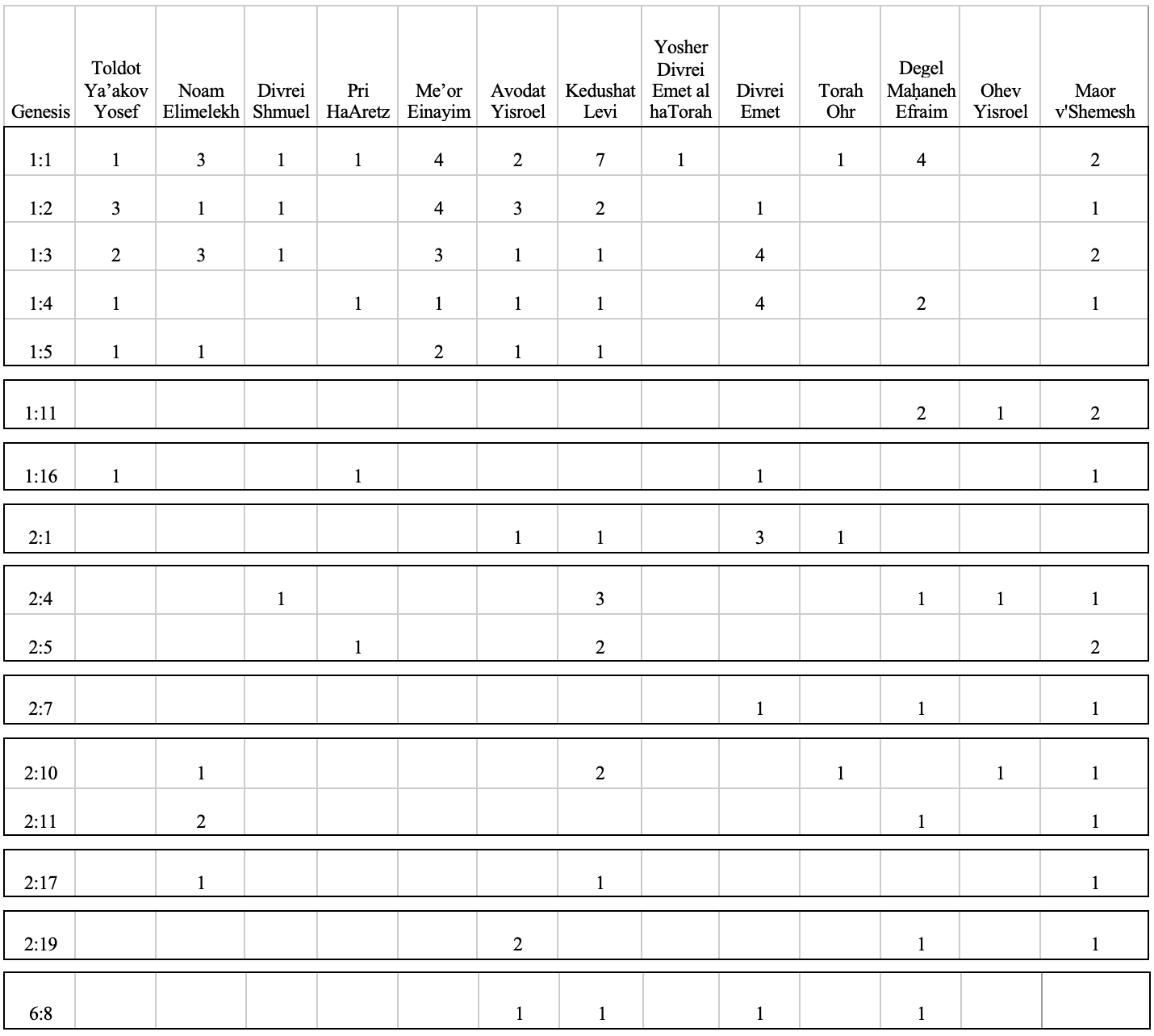
From this we can see that the favorite passages by far are Genesis 1:1-5, which detail the very beginnings of creation; followed by 1:11, about the sprouting of vegetation; 1:16, the making of the two great lights; 2:1, the end of the Genesis 1 account and the first line of the Kiddush for Friday night; 2:4-5, the beginnings of the second creation narrative which is by traditional commentators more often interpreted as the detailed account of the creation of Man which was somewhat skimmed over in the Genesis 1 version; 2:7, God breathes life into the man He has formed; 2:10-11, “A river flows Eden… the first was called Pishon” two verses which are used in connection to the various older Kabbalistic interpretations (such as the Zohar).[70] Gen. 2:17, on not eating from the Tree of Knowledge; 2:19, God forming all the wild beasts; 6:8, and finally Noaḥ finds favor is God’s eyes. The reason why these particular verses are so well-loved has much to do with past interpretations, such as the Zohar and the commentary of Nachmonides, as well as Midrashic and Talmudic sources. To trace all of these sources to (be sweetened in their) roots is a project which would certainly be a worthy endeavor, yet also one which would require many more pages to present.
Conclusions:
This study has set out, through close examination and broad comparison, to show that the early Hasidic masters sought to infuse the narrative of creation found in Parashat Bereishit with ethical teachings as a part of their desire to make Torah relevant to their followers’ daily lives. As I have shown, the earlier books of Kabbalah and Musar teachings such as Tomer Devorah, Etz Haim, and the Zohar had a particularly profound influence on these authors. Arthur Green notes that “by the late eighteenth century, the Lurianists had mostly won the battle over the definition of Kabbalah.”[71] On account of this, Green argues that Hasidism and the works that grew out of the movement cannot be considered “Kabbalah,” although “Hasidism used kabbalistic language in a less than technical sense, most often psychologizing symbols that previously had held a primarily theosophical valence.”[72] Rather than reading the creation narrative in an attempt to understand the nature of God, the Hasidic authors read it in an attempt to understand themselves.
Toldot Ya’akov Yosef resolves a conflict between switching the order of “Heaven” and “Earth” between Genesis 1:1 and 2:4 and the issue found in Genesis 1:16 of “two great lights” by relating each in turn to types of people; first is sometimes the greater and sometimes the lesser light, just as the “Heavens” is second in 1:1 and first in 2:4. Being great in R. Jacob Joseph’s eyes is not necessarily about how many Mitzvot you perform each day, rather it is the one who shares from what he has, be it knowledge or wealth.
In Noam Elimelekh, we see that there are three levels of service that can be ascended to attain Deveikut with God. By reaching the highest level of spiritual focus and awareness, a righteous person can perform that for which the entire world was created—the raising of the holy fallen sparks that God left in their lowly state just so the Tzaddik would have a purpose in life. Reaching this level is dependent not only on performing study and right religious actions, but on doing so for its own sake, which is to say the intention of the action is perhaps more important than the action itself.
Pri haAretz, shares that the Tzaddik who seeks to make the world a place of more divinity must do so by nullifying his own ego, his sense of self which allows for greater indwelling of divinity—similar to the Buddhist understanding of the process required to reach enlightenment. Acting in a way that reminds us of Cordovero’s imitatio dei, Pri haAretz asks the would-be Tzaddik to act in a way as God does; as God made nothing into something, so too the Tzaddik makes something (himself) into nothing (selfless).
Extending from Parashat Bereishit, Hasidic works more widely continue to behave in a similar fashion. The verses which are expounded are often not used to teach practical rabbinics of minute details on the performance of Mitzvot, but rather they are used to suggest ethics as a way of approaching the world. Shaul Magid states:
These Hasidic masters were deeply committed in theory and practice to the halakhic tradition, and they posited an ethics that was not bound by the very system they lived in. Menahem Mendel, for example, suggested that ethics is an outgrowth of divine love achieved through a kind of incarnation of the divine into the human vessel resulting in the “deification” and full disclosure of the human.[73]
Rather than a codification or system of piety as had come before and as the Lurianic tradition evolved into, with Hasidism the quest for truth was turned away from the truth about God, to the truth about the individual’s purpose in life. The question “What?” according to Arthur Green, was replaced by “How?”:
Hasidism is primarily a devotional mysticism. The question asked over and over again in these homilies is not “What is the nature of being?” or “How did the world come to be?” but rather “How do I properly serve God and stand in his presence?” Unlike the medieval kabbalist, who depicted esoteric lore as “the way of truth,” the hasidic authors speak of “the way of service” or devotion.[74]
While Joseph Dan has concisely stated that:
The teachings presented by these Hasidic groups are those of Jewish mystical ethics, based on kabbalistic symbolism, including some elements of Lurianic tikkun myth and the theory of the Zaddik, which originated within Sabbatian mystical heresy. But the way these teachings are preached is the traditional way of Hebrew ethical and homiletical literature, combining interpretations of biblical verses with support from talmudic and midrashic sayings, and drawing from all aspects of Jewish culture, from The Duties of the Heart, originally a fiercely rationalistic work, to the imitatio dei notions of the school of Cordovero.[75]
I will add to this that a major trend in Hasidic literature is to use Parashat Bereishit to teach such devotional mystical ethics, as we have seen, through the creation narrative by using metaphor—in particular connecting the two great lights and “Heaven and Earth” as dichotomic symbols for typecasting human behavior. In doing so, these Hasidic masters turn the esotericism of the creation narrative into relatable teachings of ethics for daily life which can be shared without concern for prior initiation and can be appreciated by even the least observant practitioner of Judaism.
End Notes:
[1] For more on the intentional inaccessibility of kabbalistic language see my paper “At Once Gate and Gatekeeper: Mystical Poetry and Mathematical Equations As Symbolic Language for Rendering and Restricting Knowledge for the Initiated” submitted to Dr. Eitan Fishbane in partial fulfilment of requirements for JTH 5499: The Zohar as Mystical Poetry.
[2] David Biale, et al. Hasidism: A New History. Princeton, New Jersey: Princeton University Press. 2018. 159.
[3] Gershom Gerhard Scholem, and Lichtheim, George. Major Trends in Jewish Mysticism. Schocken Paperbacks; SB5. New York: Schocken Books, 1961. 328.
[4] Lawrence Fine. Physician of the Soul, Healer of the Cosmos: Isaac Luria and His Kabbalistic Fellowship. Stanford, California: Stanford University Press. 2003. 81.
[5] Patrick B Koch. Human Self-Perfection: A Re-Assessment of Kabbalistic Muser-Liturature of Sixteenth-Century Safed. Culver City: Cherub Press. 2015. 78.
[6] Hebrew text extracted from Sefaria.org and checked against Moshe Cordovero, trans. Miller, R. Moshe. The Palm Tree of Devorah. Jerusalem, Israel: Targum Press; 1993. 23-27. Translation above is my own.
[7] Ibid.
[8] Lawrence Fine. Safed Spirituality: Rules of Mystical Piety, the Beginning of Wisdom. Classics of Western Spirituality. New York: Paulist Press, 1984. 84-85.
[9] Ibid. 152.
[10] It would indeed be beyond the scope of this study to describe with any detail the circle of the Ba’al Shem Tov. For such an account, see Biale, et al, Arthur Green, Miles Krassen, or Gershom Scholem.
[11] Ibid.. 326. Although Scholem here defends and even praises the Ḥasidic homiletical style as being “comparatively modern” Ora Wiskind-Elper takes the opposite view and says that “[H]asidic homiletical works—abstruse and uninviting, obscure in content and awkward in style—came to scholarly attention somewhat later.” See Ora Wiskind-Elper. Hasidic Commentary on the Torah. London: Liverpool University Press. 2018. 14.
[12] Dan, Joseph. Jewish Mysticism and Jewish Ethics. Lanham, Maryland: Rowman & Littlefield Publishers, Inc. 1996. 141.
[13] Translation and emphasis own. Text transcribed from Avodat Yisroel. Bnei Brak: Peer Mikdoshim. 2012. ד.
[14] Wiskind-Elper. Hasidic Commentary on the Torah. 36.
[15] Wiskind-Elper. 36. See also Miles Krassen. Uniter of Heaven and Earth Rabbi Meshullam Feibush Heller of Zbarazh and the Rise of Hasidism in Eastern Galicia. SUNY Series in Judaica. Albany, N.Y.: State University of New York Press, 1998. 37.
[16] Biale, et al. 65.
[17] All translations are my own, only otherwise indicated except biblical verses, which are from the New JPS translation (1985). Hebrew Text for Toldot Ya’akov Yosef and others, unless indicated, are extracted from Sefaria.org and confirmed by consultation with printed editions listed in Bibliography. I have in most instances expanded contractions for clarity.
[18] For the purposes of this study, I have selected paragraphs from each rabbi’s commentary on the parsha. For Toldot Ya’akov Yosef, I do not begin at the beginning of his exegesis, but rather at the beginning of his comments based directly on the parasha text (Gen. 1:1), which is in actuality towards the end of his section on Bereishit.
[19]Toldot Yaakov Yosef. Vol. 1. 2 vols. Jerusalem: Sifrei Or haHayim. 2007. 47.
[20]Etz Ḥaim by Vital, Divrei David by David ben Samuel, Yeri’ot Shlomo by Shlomo Luria, “A certain book” by unnamed author, and Tractate Beitzah of the Babylonian Talmud.
[21] Scholem. 335.
[22]Toldot Yaakov Yosef. 47.
[23]Toldot Yaakov Yosef. 48.
[24]וזה שנאמר ביום עשות ה' אלקים ארץ ושמים, שהקדים אנשי החומר הנקרא ארץ לשמים בעלי הצורה כמו שהקדים זבולן ליששכר מטעם הנזכר שם.
“This is what was said, “When the LORD God made earth and heaven” (Gen. 2:4), that the materialistic people who are called Eretz/Earth are mentioned before [those called] Shamayim/Heaven—the spiritual people, just as Zebbulon is before Issachar for the reason mentioned there.”
[25]Toldot Yaakov Yosef. 48.
[26] Scholem. 330.
[27] Ibid.
[28] Ibid.
[29] “Both, he concludes bitterly, are the case.” Biale, et al. 167.
[30] Wiskind-Elper. Hasidic Commentary on the Torah. 70..
[31] Shmuel Shmelke was born in 1726, making Elimelekh of Lizhensk 9 years older. "Horowitz, Samuel Shmelke of Nikolsburg ." Encyclopaedia Judaica. . Encyclopedia.com. (April 16, 2021). https://www.encyclopedia.com/religion/encyclopedias-almanacs-transcripts-and-maps/horowitz-samuel-shmelke-nikolsburg
[32] "Elimelekh of Lizhensk ." Encyclopedia of Religion. . Encyclopedia.com. (April 17, 2021). https://www.encyclopedia.com/environment/encyclopedias-almanacs-transcripts-and-maps/elimelekh-lizhensk
[33] See chart “Cross Reference of Verses” in Appendix 1
[34] See note 8.
[35]Noam Elimelekh. Bnei Brak: Peer Mikdoshim. 2013. א.
[36]Noam Elimelekh. א.
[37] The following paragraph is presented out of order of appearance in the drash, but is included at this point on account of the corresponding nature of its material and theme.
[38] JPS 1917 edition.
[39]Noam Elimelekh. ז.
[40] b. Pesaḥim 50b. Quoted in the drash (homily) by Elimelekh, see Noam ElimelekhParashat Bereishit, paragraph 16 in Appendix entry 2(b).
[41]Noam Elimelekh. א.
[42]Noam Elimelekh. ב.
[43] Biale, et al. 165-166.
[44]Noam Elimelekh. See above note 19.
[45] For a thorough examination of this myth, see Lawrence Fine, Physician of the Soul, Healer of the Cosmos: Isaac Luria and His Kabbalistic Fellowship. Stanford, CA: Stanford University Press. 2003. 134-138.
[46] The Peer Mikdoshim edition of Noam Elimelekh contains a bracketed citation for עץ חיים שער רפ׳׳ח פ׳׳א
[47]Noam Elimelekh. ח.
[48] Rabbi Elimelekh apparently miss-quotes the Gemara here, in comparison with the Vilna text, which reads ואלמלא הקב"ה עוזרו אין יכול לו
[49]Noam Elimelekh. ח.
[50] Daniel Matt. The Zohar: Pritzker Edition. Vol 1. Stanford: California. Stanford University Press. 2004. 109. See also Rashi’s comment on “Meraḥefet.”
[51] Biale, et al. 168
[52] Arthur Green. The Light of the Eyes: Homilies on the Torah. Stanford, California: Stanford University Press. 2021. 27.
[53] For a wonderfully detailed account of Menaḥem Mendel of Vitebsk immigration to Israel see Mor Altshuler. "The First Tzaddik of Hasidism: The Zlotchover Maggid and His Circle." Jewish Studies Quarterly 11, no. 1/2 (2004): 178-191.
[54] Martin Buber, trans. Marx, Olga. Tales of the Hasidim: Early Masters. New York: Schocken Books, Inc. 1968. 176.
[55] Ibid. 1.
[56] Ibid. “His Childhood,” 175; “Seasons,” 178; and “The Heap of Cinders,” 178.
[57]Pri haAretz. Jerusalem: Hamesorah. 2006. ט.
[58] Ibid.
[59] This idea is elaborated in the writing of Ya’akov Abuchatzeira, Pituchei Chotam, Parashat Pekudei.
[60] This idea is developed in Shaar haYiḥud chapter 3 of the Tanya: “...the term YESH (“existance”) can be applied to all created things only [as they appear’ to our corporeal eyes, for we do not see nor comprehend at all the the source, which is the spirit of G-d, that brings them into existence. Therefore, it appears to our eyes that the materiality, grossness and tangibility of the created things actually exist, just as the light of the sun appears to have actual existence when it is within its source.” (Rabbi Schneur Zalman of Liadi. Likkutei Amarim Tanya: Bi-lingual Edition. New York: Kehot Publication Society. 2012. 295.) Indeed, this understanding of what is or is not “reality” is very similar to Buddhist teachings that an important aspect of attaining enlightenment is the realization that all is connected and there is no “self” independent of everything else (see Anālayo. “Dhammas: The Sense-Spheres” in Satipaṭṭhāna: The Direct Path To Realization. Cambridge: Windhorse Publications. 2003.). For R. Menahem Mendel and the Tanya, this concept is less about the relation of the self to the world than it is about the relation between the world and God (which naturally includes the self).
[61] Mor Altshuler. "The First Tzaddik of Hasidism: The Zlotchover Maggid and His Circle." Jewish Studies Quarterly 11, no. 1/2 (2004): 154. http://www.jstor.org/stable/40753353.
[62]Pri haAretz. ט.
[63]Pri haAretz. ט–י.
[64] Shaul Magid. “Jewish Ethics Through a Hasidic Lens.” In Hasidism Incarnate : Hasidism, Christianity, and the Construction of Modern Judaism, 51-80. Stanford: Stanford Univ. Press. 2015. 53-62.
[65] See complete table in Appendix. Fig. 1.
[66] See page 13.
[67]Pri haAretz. ט.
[68]Toldot Ya’akov Yosef: 6 Biblical (Gen. 1:1, Gen. 2:4, Ps. 61:8, Gen. 1:16 [twice], Ps. 89:3); 1 Mishnaic (Pirkei Avot 3:7); 1 Midrashic (Shemot Rabbah 31:5); 1 Talmudic (Beraḥot 17b); 2 Kabbalistic (Etz Ḥaim, Zohar)
Noam Elimelekh: 8 Biblical (Gen. 1:1, Gen. 1:2 [thrice], Gen. 1:3, Gen. 1:4, Deut. 11:14, Eccl. 11:6); 2 Mishnaic (Avot1:2, Avot 1:18); 1 Midrashic (Bereishit Rabbah 1:4); 3 Talmudic (b. Pesaḥim 50b, b. Ta’anit 2a, b. Kiddushin 30b); 1 Rashi (on Gen 1:1);
Pri haAretz: 6 Biblical (Gen. 1:16, 1 Chron. 29:11, Ps. 8:4-5, Zach. 4:14, Ps. 119:62, 2 Sam. 14:14); 1 Talmudic (Ḥagigah 12b)
[69] For full explanation of table, see Appendix, Fig. 1.
[70] See Melila Hellner-Eshed. “A River Flows From Eden: Verses of Awakening and Arousal.” in A River Flows From Eden: The Language of Mystical Experience in the Zohar. Stanford, California: Stanford University Press. 2009. 229-251.
[71] Green. The Light of the Eyes. 47.
[72] Ibid. 48.
[73] Magid. 78.
[74] Green. 52.
[75] Dan. 147-148.
Appendix
1. Cross Reference of Biblical Verses Quoted In Early Ḥasidic Commentaries, Parashat Bereishit (Genesis 1:1-6:8):
Verses with no references in any volume were left off the chart to manage the size of this document. The columns are each book, the far left column is the verse by chapter:verse number, and the numbers in each column represent the number of times the particular verse is referenced n that work. For example, Toldot Ya’akov Yosef on Parashat Bereishit cites Genesis 1:1, once, and cites Genesis 1:2, three times.



[Fig. 1]
